The wind had pressed down the grasses below, resembling the matted fur of a cat. A village had grown around the dirt strip that formed the airstrip, like villages at the edge of the sea. Children appeared from the circular mud houses, completely naked and caked in dust. The early morning sun reflected off the particles, giving them a white, ghost-like appearance. Everyone wore Western clothing, each probably only owning one piece as it hung on their body like a fishing net thrown over a pier.
Weston, the USAID expert, deplaned with his five pieces of luggage. I wondered how long he would stay. A large SUV pulled up, and a few Sudanese helped load the luggage into the back. One of them greeted him, either having seem him or his name before. He turned to take a picture of our plane, and I had an amusing mental picture of a white man taking a picture of me, surrounded by Sudanese children all looking at him as the oddball in their midst.
Why did this man bring all those things with him? What could he possibly need all them for? Were they gifts to others? Would he be seen again before the plane arrived to take him away? How long would that be? And where did all this money come from? Was he some rich king from afar? Where all white men kings?
These questions I asked myself, wondering what the children were thinking. Looking back at them, they had suddenly grown clothes, save one. He was the least self-conscious of them all. His eyes met mine and his smile cracked his head open, triggering a crack into my world and face. He began to dance, and I mimicked his movements. Turning to one another, he and his companions burst into hardy laughter. I smiled back.
The plane began to rumble, the tension mounting, twisting the metal craft into a spring ready for launch. Dust swirled around the Sudanese, and they shielded themselves by closing their eyes and turning their heads aside. When the dust had settled, we would be gone, save for the distant hum of our craft. The show was over, folks. Back to regular life.
Wait, where did our visitor go?
Sunday, January 22


Saturday, January 21
Camera Barrier
African children swarmed around me, there faces white with the dust from the aircraft. We descended into their midst, only to rise again and leave. This was a fuel stop, yet I felt like we were taking more than their fuel. Some cultures believed that taking a picture meant you stole their soul. Was this one of those?
I took pictures of the Sudanese refilling the UN plane. Maybe I’d catch some of the background action in my candid shots. The children kept staring at me, the only white visitor; hardly an invited guest. I smiled, lifting my hand slightly in a timid wave. Their heads cracked open in brilliant white smiles. How could such a gesture of pleasure be so universal?
One of them pointed at the device in my hand, then motioned to his chest, held prominent. I said, “Picha?” He nodded in eager agreement, immediately posing like Mohammed Ali. Soon I was mobbed like the famous boxer, trading time snapping shots and showing them to the kids. They grabbed and pointed, laughed and shrieked, seeing themselves perhaps for the very first time. Many of them would point at the picture on the screen and indicate to a friend that it was him/her.
I looked up to see the pilot waiting for me. “Tuko tayari?” I asked, at the same realizing that everyone else was already on the plane and ready to go. He nodded. I had to pry away from the kids, then a guy my age cracked a couple of them on the head to send them scattering. I hopped onto the plane, waving goodbye like a celebrity who didn’t have enough time to sign autographs for his fans. Crammed back in my seat, I stared out the window, wondering what world I had just woken from.
Rubbing my nose, dirt fell from my hand and into my lap. I brought out the hand-sanitizer, squirting a big glob onto my hands. Cradling my hands together, no surface area was left uncovered with the goop before it miraculously evaporated. Would my memories just as easily disappear? I hope not. I hope they are incorporated into my being, becoming a part of who I am and who I want to be. Only then will I never forget.
I took pictures of the Sudanese refilling the UN plane. Maybe I’d catch some of the background action in my candid shots. The children kept staring at me, the only white visitor; hardly an invited guest. I smiled, lifting my hand slightly in a timid wave. Their heads cracked open in brilliant white smiles. How could such a gesture of pleasure be so universal?
One of them pointed at the device in my hand, then motioned to his chest, held prominent. I said, “Picha?” He nodded in eager agreement, immediately posing like Mohammed Ali. Soon I was mobbed like the famous boxer, trading time snapping shots and showing them to the kids. They grabbed and pointed, laughed and shrieked, seeing themselves perhaps for the very first time. Many of them would point at the picture on the screen and indicate to a friend that it was him/her.
I looked up to see the pilot waiting for me. “Tuko tayari?” I asked, at the same realizing that everyone else was already on the plane and ready to go. He nodded. I had to pry away from the kids, then a guy my age cracked a couple of them on the head to send them scattering. I hopped onto the plane, waving goodbye like a celebrity who didn’t have enough time to sign autographs for his fans. Crammed back in my seat, I stared out the window, wondering what world I had just woken from.
Rubbing my nose, dirt fell from my hand and into my lap. I brought out the hand-sanitizer, squirting a big glob onto my hands. Cradling my hands together, no surface area was left uncovered with the goop before it miraculously evaporated. Would my memories just as easily disappear? I hope not. I hope they are incorporated into my being, becoming a part of who I am and who I want to be. Only then will I never forget.
Friday, January 20
Loki
The clouds parted and below lay huge swaths of browns, yellows and whites. To one side, an ocean of sand stretched as far as the eye could see. On the other, dry river beds resembling the muddy streams of the Mississippi Delta meandered into the distance, trickling down distant dark mountain tops.
Loki (“LOW-key”), short for Lokichoggio, is said to be busier than Kenyatta International in Nairobi. This town is the central base for most of the humanitarian efforts in the Sudan, Uganda and other sites in the African Interior. There is a huge UN compound nearby, and at least half of the vehicles are part of some UN program: FAO, WFP, UNICEF, etc. There were all kinds of other NGOs, from Samaritan’s Purse to CEAS (Church Ecumenical Action in Sudan) and Medicins sans Frontiers to Vetinarians without borders, each with their own vehicle.
So what does the UN and all these other NGOs drive? None other than the Toyota LandCruiser. They come in all shapes and sizes here, from pick-up trucks to full-blown defenders. I thought I had walked onto a set for a movie or documentary on some human relief crisis.
We loaded into the vehicle with CEAS logo on the side and drove into town. I was immediately reminded of La Concordia, a border and outlaw town in Ecuador I had spent three weeks in two years ago. The main road was superb for Africa, a tarmacked blade cutting through time immortal. Yet change was happening. Bars had crept into these traditional structures of mud, grass and tin, spilling their beer and alcohol into the streets and flooding the town with other “relief” efforts.
We arose early to catch our 6:20 AM flight. We arrived at 6:30 AM when the airport opened. Such are the ambitious in this remote area. Our group of 5 outnumbered the other two passengers and pilots. The cool desert air hid secret the adventures to come, tingling my senses and making me believe I was hallucinating. So far, so good- I haven’t woken up, and I’m still alive.
Loki (“LOW-key”), short for Lokichoggio, is said to be busier than Kenyatta International in Nairobi. This town is the central base for most of the humanitarian efforts in the Sudan, Uganda and other sites in the African Interior. There is a huge UN compound nearby, and at least half of the vehicles are part of some UN program: FAO, WFP, UNICEF, etc. There were all kinds of other NGOs, from Samaritan’s Purse to CEAS (Church Ecumenical Action in Sudan) and Medicins sans Frontiers to Vetinarians without borders, each with their own vehicle.
So what does the UN and all these other NGOs drive? None other than the Toyota LandCruiser. They come in all shapes and sizes here, from pick-up trucks to full-blown defenders. I thought I had walked onto a set for a movie or documentary on some human relief crisis.
We loaded into the vehicle with CEAS logo on the side and drove into town. I was immediately reminded of La Concordia, a border and outlaw town in Ecuador I had spent three weeks in two years ago. The main road was superb for Africa, a tarmacked blade cutting through time immortal. Yet change was happening. Bars had crept into these traditional structures of mud, grass and tin, spilling their beer and alcohol into the streets and flooding the town with other “relief” efforts.
We arose early to catch our 6:20 AM flight. We arrived at 6:30 AM when the airport opened. Such are the ambitious in this remote area. Our group of 5 outnumbered the other two passengers and pilots. The cool desert air hid secret the adventures to come, tingling my senses and making me believe I was hallucinating. So far, so good- I haven’t woken up, and I’m still alive.
Thursday, January 19
The Great Depression
"Hey, can you get me a job?"
I'm asked this question as often as I'm asked for money. My first reaction was to be incredulous- Why am I being asked this question? Is it be cause I'm white? Is it beacuse I obviously have money, and therefore a job? Is it because of colonialism and British employing the Nationals?
These questions dissolve into annoyance, as the tension in my brain transfers to the muscles in my neck and shoulders. I want to snap, "Why don't you get yourself a job?!" All of these people are men, and they are usually dressed quite well in a suit resembling one from GoodWill in the States. They seam perfectly capable of working- so why are they asking me for a job?
On a morning run I passed by a group of men standing in front of a locked gate. They seemed to be waiting for the gate open and a man to call a few of them in. It was a scene right out of Cinderella Man from the Great Depression. As I ran by, a few men followed my movement. I was a free man, running on some type of job, while they were stuck, waiting, thinking...
What's the difference? What makes me different from them? Where I was born? The color of my skin? My education level?
Kenya's unemployment rate is somewhere in the neighborhood of 25-40%. Many people employ themselves in the informal sector, in non-taxed and non-registered business activities. During the morning and afternoon traffic jams, hawkers float amongst their customers jailed in steal cages, hoping for a window of opportunity to open and keep them fed for one more day. I hear about all kinds of scams, especially from those who beg, and still I wonder how anyone - and especially myself - would survive in such a situation.
I finished my run, taking a cool-down walk past my apartment complex. A young man, his clothes hanging from his body like moss on a frail oak tree, stoops over a pile of garbage. In one hand he holds a bag of trash, aka small treasures to sell to only he knows who. The words "garbage collector" take on a whole new meaning.
He looks up as I look away, and the question hangs heavy in the crisp morning air:
"What do you do for a living?"
I'm asked this question as often as I'm asked for money. My first reaction was to be incredulous- Why am I being asked this question? Is it be cause I'm white? Is it beacuse I obviously have money, and therefore a job? Is it because of colonialism and British employing the Nationals?
These questions dissolve into annoyance, as the tension in my brain transfers to the muscles in my neck and shoulders. I want to snap, "Why don't you get yourself a job?!" All of these people are men, and they are usually dressed quite well in a suit resembling one from GoodWill in the States. They seam perfectly capable of working- so why are they asking me for a job?
On a morning run I passed by a group of men standing in front of a locked gate. They seemed to be waiting for the gate open and a man to call a few of them in. It was a scene right out of Cinderella Man from the Great Depression. As I ran by, a few men followed my movement. I was a free man, running on some type of job, while they were stuck, waiting, thinking...
What's the difference? What makes me different from them? Where I was born? The color of my skin? My education level?
Kenya's unemployment rate is somewhere in the neighborhood of 25-40%. Many people employ themselves in the informal sector, in non-taxed and non-registered business activities. During the morning and afternoon traffic jams, hawkers float amongst their customers jailed in steal cages, hoping for a window of opportunity to open and keep them fed for one more day. I hear about all kinds of scams, especially from those who beg, and still I wonder how anyone - and especially myself - would survive in such a situation.
I finished my run, taking a cool-down walk past my apartment complex. A young man, his clothes hanging from his body like moss on a frail oak tree, stoops over a pile of garbage. In one hand he holds a bag of trash, aka small treasures to sell to only he knows who. The words "garbage collector" take on a whole new meaning.
He looks up as I look away, and the question hangs heavy in the crisp morning air:
"What do you do for a living?"
Wednesday, January 11
Many Wants, One Need

I accompanied my boss, Dan, and our driver, Andrew, to the Rift Valley today to a small school. Some time ago, they had provided funds to help establish the school in the land of the Masai, where education is low and most of the adults are illiterate. A gal in the U.S. decided that for her Bar Mitzvah, she would have all her presents go towards donations for school supplies to these children. Today we delivered those supplies to the teachers and students. Unfortunately, many children were not there because their families had migrated in search of water for their livestock.
Much of the rural areas in Kenya are suffering from a prolonged drought. While rains are expected soon in this area, the earth dams no longer hold water and women trek 15 kms to fetch water from a river. While they gratefully accepted our gifts of paper and pencils, what they really could use is water. I interviewed two women, Annette and Christine, about the situation. This information will be used in a proposal a group of churches is submitting next week for funds to combat the impending crisis. I only hope we're not too late.
Mary Manjiru, pictured below, is one mother living near the school. Her son, Jonathon Moses, also pictured below, is able to attend school during the drought, unlike many of his agemates. Jonathon was one of the few people I spoke to who understood my English quite well.
On the way back, we stopped at a quaint hotel for lunch. I went to the bathroom to wash my hands. I let the water run through my fingers, washing away the dust and grime. I paused only a moment to reflect on where that water was running to, and where I might be running from. Abruptly, I turned off the water, leaving my hands still cool, wet and slimy from the remaining suds.
There is water here. It's just not available to those who desperately need it.
Wednesday, December 28


Tuesday, December 27


Monday, December 26


Sunday, December 25
Christmas in Kenya
From December 22nd to the New Year, I'm blessed and fortunate enough to have my family with me. What follows are words from my mother about our experience here with Kenyan children in Kikuyu, a small village outside of Nairobi. Being with my family and sharing our time with various Kenyans made for wonderful fellowship; one I'm just beginning to put into words.
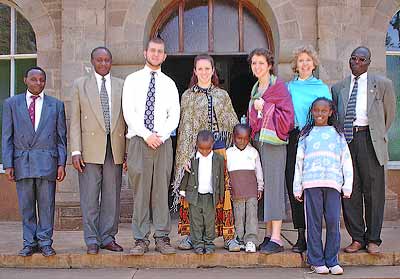
The first week we spent primarily engaged in mission outreach with more than eighty needy children. It was physically and emotionally challenging. Most days a warm shower was elusive and we were falling asleep by 9:00 p.m [when we weren’t playing cards as a family or up talking]. Yet, I also realize that my time in Kenya was a remarkable personal Sabbath; a break from the oppressive consumerism and secularization of Christmas— the constant commercials, the garish store decorations and overwhelming materialism. In Kenya we experienced no frenzy of holiday shopping around us, no circling of parking lots, no pervasive muzak, no shortness of tempers.
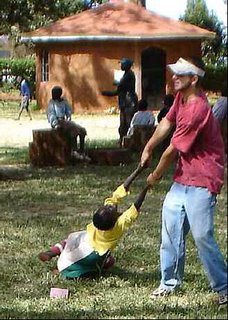 It struck us that from the time we arrived December 21, until the day we left January 1, we heard only one reference to Santa. Some boys at the Wee School were washing their football (soccer) jerseys in preparation for an upcoming game. They had three pails of water on the ground, and were robust in their immersing and scrubbing and rinsing. One of the boys playfully put suds around the lower half of his face, and looked up at us saying, “See, I’m Father Christmas!”
There was no talk of Santa or presents, and yet we interacted with children of varied means everyday. The children asked nothing of us but to hold their hand or jump rope with them, kick the soccer ball or get Evans to clasp their arms and swing them around. They were truly grateful for the T-shirts we brought them from you at Westminster, the puppet theatre we constructed while there, the puppets made for them by our Youth Club kids, but more than anything they valued the time we spent with them—our mere presence.
In the original Hebrew, Sabbath literally means “to cease.” At its best Sabbath allows us to stop, to get away from work and busyness, and to experience God’s grace in simply being. Kenya afforded us a remarkable escape from the Christmas hype here at home. It was a tremendous gift to experience Christmas not as a shopping extravaganza replete with indulgent celebrations, but as a time of reconnection with God, others, and our own souls.

In one journal entry I wrote:
“Perhaps I’m clarifying the need to reclaim Christmas from our commercialist consumer society—to restore Christmas to a family and faith centered celebration. Not to overlook or ignore the lonely or homebound, the poor, hurting or needy, but to try to distance ourselves from malls and excess. It feels like one has to leave town (or one’s country!) in order to find this.”
Kenya gave us a taste of a simpler, dare I say more meaningful, Christmas. In our time spent being together as a family and forming new friendships, we continuously felt the powerful presence and peace of Immanuel—Godwithus.
Grace and gratitude,
Anne
The first week we spent primarily engaged in mission outreach with more than eighty needy children. It was physically and emotionally challenging. Most days a warm shower was elusive and we were falling asleep by 9:00 p.m [when we weren’t playing cards as a family or up talking]. Yet, I also realize that my time in Kenya was a remarkable personal Sabbath; a break from the oppressive consumerism and secularization of Christmas— the constant commercials, the garish store decorations and overwhelming materialism. In Kenya we experienced no frenzy of holiday shopping around us, no circling of parking lots, no pervasive muzak, no shortness of tempers.

There was no talk of Santa or presents, and yet we interacted with children of varied means everyday. The children asked nothing of us but to hold their hand or jump rope with them, kick the soccer ball or get Evans to clasp their arms and swing them around. They were truly grateful for the T-shirts we brought them from you at Westminster, the puppet theatre we constructed while there, the puppets made for them by our Youth Club kids, but more than anything they valued the time we spent with them—our mere presence.
In the original Hebrew, Sabbath literally means “to cease.” At its best Sabbath allows us to stop, to get away from work and busyness, and to experience God’s grace in simply being. Kenya afforded us a remarkable escape from the Christmas hype here at home. It was a tremendous gift to experience Christmas not as a shopping extravaganza replete with indulgent celebrations, but as a time of reconnection with God, others, and our own souls.

In one journal entry I wrote:
“Perhaps I’m clarifying the need to reclaim Christmas from our commercialist consumer society—to restore Christmas to a family and faith centered celebration. Not to overlook or ignore the lonely or homebound, the poor, hurting or needy, but to try to distance ourselves from malls and excess. It feels like one has to leave town (or one’s country!) in order to find this.”
Kenya gave us a taste of a simpler, dare I say more meaningful, Christmas. In our time spent being together as a family and forming new friendships, we continuously felt the powerful presence and peace of Immanuel—Godwithus.
Grace and gratitude,
Anne
Saturday, December 17
Mat Ride
Dodging people while walking purposefully, I navigated the streets of downtown Nairobi with ease. I approached a tinted, thumping matatu (or simly "mat") parked on a side street. Peering in, I saw a couple of people sitting inside. The conductors, young men with red vests who collect the fares on these small vans, pulled me on the shoulder to get inside. "Westlands! Mbao! Mbao!"
While I was headed to Westlands and thought the price fair (20 Kshs, or about 25 cents), I knew they wouldn't leave until the mat was full. As I stood there waiting non-chalantly in my sunglasses and baseball cap, a few women passed me to get on board. With a few spots left, I decided to board. The Kenyan passengers simply sat there, as if the bumping music wasn't shaking their bones or about to rattle off a piece of the mat.
No sooner had I taken my seat than a police officer appeared and began yelling at the driver through the passenger's side window. The driver immediately gunned the engine as the conductors scattered... only to reappear onboard at the next block. Adeptly dodging other cars and mats, the driver bullied us through the free-for-all traffic of Nairobi.
Soon we found ourselves stuck in the lunch-hour traffic (yet if it's business hours then there's sure to be traffic in Nairobi). Hakuna Matata: Our driver swiftly swerved off the road, creating his own way past the line of traffic along the dirt and stone path for pedestrians. People jumped out of the way as we careened past, occasionally cutting through oncoming traffic and then back off the road again.
Crouched in my crammed seat, I hung onto the seat in front of me to keep from flying side-to-side inside the mat. Every so often we'd stop and the conductor would invite more people on board. All passengers were not guaranteed a seat, much less a seat belt, despite government regulations. After a thrilling 10-minute roller coaster ride, we arrived in my neighborhood of work, Westlands. I dutifully gave my 20 bob coin to the conductor as I deboarded. "Asanti."
I thanked him for not just getting me to my destination, but doing it in thrilling, Kenyan-like fashion.
While I was headed to Westlands and thought the price fair (20 Kshs, or about 25 cents), I knew they wouldn't leave until the mat was full. As I stood there waiting non-chalantly in my sunglasses and baseball cap, a few women passed me to get on board. With a few spots left, I decided to board. The Kenyan passengers simply sat there, as if the bumping music wasn't shaking their bones or about to rattle off a piece of the mat.
No sooner had I taken my seat than a police officer appeared and began yelling at the driver through the passenger's side window. The driver immediately gunned the engine as the conductors scattered... only to reappear onboard at the next block. Adeptly dodging other cars and mats, the driver bullied us through the free-for-all traffic of Nairobi.
Soon we found ourselves stuck in the lunch-hour traffic (yet if it's business hours then there's sure to be traffic in Nairobi). Hakuna Matata: Our driver swiftly swerved off the road, creating his own way past the line of traffic along the dirt and stone path for pedestrians. People jumped out of the way as we careened past, occasionally cutting through oncoming traffic and then back off the road again.
Crouched in my crammed seat, I hung onto the seat in front of me to keep from flying side-to-side inside the mat. Every so often we'd stop and the conductor would invite more people on board. All passengers were not guaranteed a seat, much less a seat belt, despite government regulations. After a thrilling 10-minute roller coaster ride, we arrived in my neighborhood of work, Westlands. I dutifully gave my 20 bob coin to the conductor as I deboarded. "Asanti."
I thanked him for not just getting me to my destination, but doing it in thrilling, Kenyan-like fashion.
Subscribe to:
Posts (Atom)
