Wednesday, February 15

The Drought's Carnage


Reality Hits Hard:
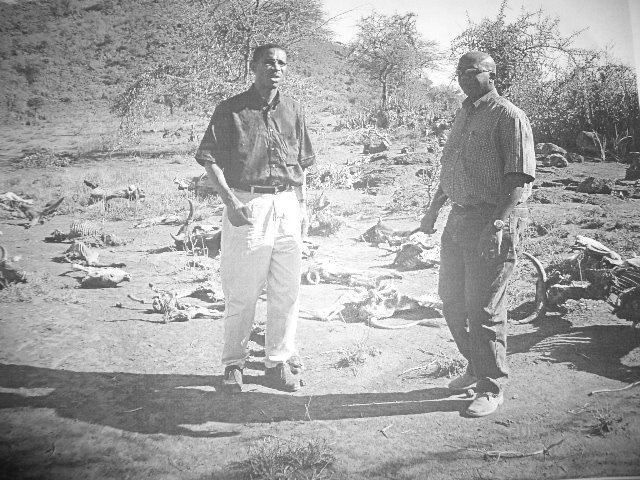
Cattle carcasses litter the ground around two community workers.


Kenyan continues to go without a drop of water. The government has bought a few cattle from the vast herds who await the same fate as these in the picture above. Yet even as the Kenyan government seeks aid for drought relief, the government is plagued by corruption scandals leading all the way up to the Vice President. Any sort of aid, for drought or development, will likely be withheld until decisive action is taken to investigate these allegations. Church World Service will soon be receiving and implementing (through our partners) a relief fund from ACT (Action by Churches Together) in Geneva. However, our project was supposed to fill-in the gaps of the government's.

Meanwhile, our apartment is without running water now for over a week; a convenience withheld rather than a livelihood destroyed. I request that today you think about all the ways you use water, and what you would do if there wasn't any.

Saturday, February 11

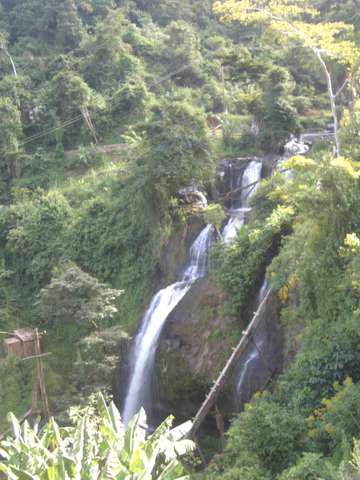
Chogoria Waterfall

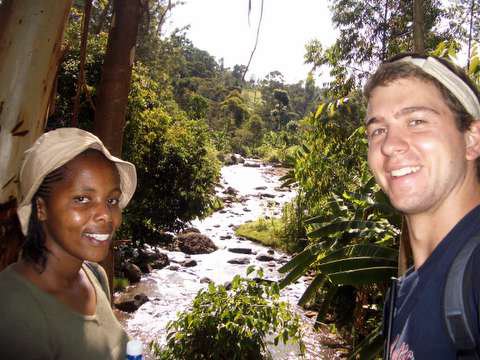
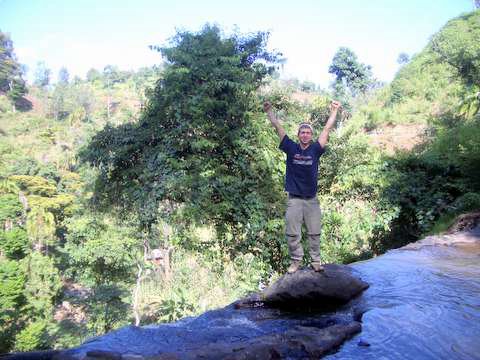
Until today, I'd been in Kenya for nearly half a year and still had yet to see a waterfall. As hard as that is to believe, I got my wish today. My friend, Nightingale, and I headed up to a town called Chogoria at the base of Mt. Kenya, Kenya's highest mountain (Kilimanjaro's peak is actually in Tanzania). We walked through beautiful greenery and some picturesque farms before finally arriving at our destination: a tumbling, 100-ft plus cascade of moving white silk. I had a wonderful time admiring the overlook, exploring a cave beneath the waterfall, and then climbing around on the rocks. The pain in my shoulders and legs reminds me that today was a very good day indeed.


Wednesday, February 8

Uganda Pics: FDNC

On the otherside of Mt. Elgon, on the border of Kenya and Uganda, is a town called Mbale. It is there where I spent my short time in Uganda (two nights). Our partner organization, FDNC (Foundation for Development of Needy Communities) is doing some wonderful work there. They focus in three broad areas: community-based health care in 32 local villages, vocational training in things from computing to carpentry, and income-generating activities like goat-rearing and brick manufacturing. They received a generous grant from the Japanese Government to expand their training center, which is a huge resource for teaching and training. They focus especially on the girl-child, many of whom are the head of household as their parents have succumbed to AIDS. I could go on and write more, but I haven’t the time and will anyway as I put together our 2005 Newsletter- due Friday! To find out more, visit their website: www.fdncuganda.org.

A Gift


A Home


A School


A Meal


A Future


Click here for more pictures from my trip to Uganda.

Tuesday, February 7

ABC's of AIDS: An American Concept?

Uganda is one of three East African nations to reduce its HIV prevalence rate. Many attribute the success to its influential ABC campaign: Abstain, Be Faithful or Use a Condom. After the nation received international acclaim for its rate reduction, its churches are no longer remaining silent on the issue. They have joined the campaign yet refuse to advocate the use of condoms, instead preferring the A&B method.

Many debate the issue of condom use and whether or not it promotes promiscuity. While not a foolproof method, using a condom properly does significantly reduce one’s risk to exposure, as reported on all AIDS awareness ads (or adverts as they call them here). However, many of the billboards and other awareness posters no longer mention condoms, instead focusing on abstinence and faithfulness. Some think the churches are to blame for this; others believe it has to do with USAID AIDS funding from the US and the Bush Administration restrictions on foreign assistance.

The jury’s still out on how much proper condom use has reduced those being infected with HIV/AIDS. One middle-aged Ugandan said that some prostitutes in Kampala have resisted infection by insisting their clientele use condoms. He also said in his Islamic high school his teacher condemned condoms as an American tactic to kill off its enemies, particularly Africans. Apparently, condoms are widely viewed as an American concept, and many Ugandans have not taken responsible ownership in use.

A Chinese company has just introduced condom vending machines in the capital city, noting public policy in many developing nations promotes if not requires by law these contraceptives be readily available in public venues. Although the company has the condolences of the Health Minister, they have yet to find any council or corporation to buy the machines.

Says one Ugandan: “It’s hard for me to believe that the youth will listen to the simple message of ‘abstinence’ and ‘faithfulness’ when we are being punished by a government who isn’t faithful to its people,” referring to corruption in his country.

Monday, February 6

"Not by Guns or by Cheating, but by Prayer"

Uganda faces national elections in two weeks on February 23rd. An Ugandan joked that the European Union envied Africa since beating incumbent here isn’t a real option, saying he heard it on the BBC. The same could be said for the House, but I didn’t try to explain that to him. The political opponents here, however, are accused of treason, fraud and rape, spending most of their valuable campaigning time in jail or court facing the (perceived-to-be) trumped-up charges.

Around election time everything shuts down and people stop working because there’s no money in the system. The estimated US$ 20M being spent by Museveni, the current president, mostly goes to improved roads for the campaign and food for the voters. One unofficial slogan of the campaign is “eat widely, vote wisely.” All other sectors of the economy shut down as the nation prepares to weather another political storm with an inevitable outcome. Even Museveni himself said, “My opponent can’t win,” referring to Besigye, his former VP-turned-major-political-adversary (as I understand it).

We passed by a local store with a yellow poster on it, the color symbolizing the president and his reigning government. The other posters of pink and red were of his opponents. We’d been driving along a narrow dirt path used 360 days a year for walking, crushing the tall grass on either side, when we came across a small passenger car with a yellow sign on the side. A colleague informed me that it was the local MP, campaigning for the president. The driver wore a bright yellow hat with the black and red Ugandan flag on it, looking strangely familiar to ones I’ve seen at Goodwill.

Uganda is not an oppressive place. The telecommunications here are much better and cheaper than in Kenya, the roads seem to be well maintained and areas considered “dry” and without rain for months are still green, as opposed to some areas of Kenya that are “dry” after years without rain and are brown and dusty. The people can always hope for better, less self-interested leadership, but the likelihood is slim with the corruption and strong and loyal military. The few people I spoke to about politics were very careful with their words, as if someone might be listening to them that might report any criticism of the government they might say.

As one person said, the coming election won’t be won “by guns or by cheating, but by prayer.” Hope still lies in resolute faith, and I can only join their prayer for improved governance to see how God is moving this country.

Sunday, February 5

Border Crossings

I knew we were approaching the Ugandan border when I began to see a long line of stopped trucks. As a private car we simply bypassed all of these semis, reaching the border after another mile or so. There we filled out exit papers for Kenya before actually crossing a bridge with one guard to fill out entry papers for Uganda. Apparently truckers wait for at least two days to get through. All of the trucks were on the Kenyan side heading inland to Uganda, Sudan, Rwanda, DRC, etc., many of them relief aid for humanitarian and natural disasters. The process of crossing took us about 2 hours; amusing once and yet entirely frustrating when I think of all the goods being delayed for paperwork… and the security they’re trying to provide, I suppose.

Inside the Ugandan Immigration Office, a sign read something like, “Attention all customers, we have recently upgraded to a computerized system. Please forgive the delay this may cause.” I couldn’t help but chuckle at the irony of that statement.

I must brag: I have yet to meet a Kenyan with faster typing skills than my own (roughly 65 or so words a minute). And I must admit: I’ve been incredibly advantaged to grow up around computers. The vast majority of Kenyans won’t ever touch a computer unless they go to a high school or college that provides a lab. Cyber cafés are everywhere but only the few who can afford them use them. Even then their exposure is quite limited, and the discomfort from lack of continual contact readily shows. Yet because they speak English and literacy rates are fairly good, a vast world of information and opportunity lies at their fingertips: they just need the keys to unlock it.

This is why I’m going to launch the Fingertip Dream Initiative in March of this year. [Ahem, I just read the State of the Union and couldn’t resist.] Actually, I’m formulating a plan to teach computing classes at a local cyber café. It is my humble hope that I will reach people of all ages in whatever computing skills they’d like to learn. I’m still working out the details, like how to make the classes available to everyone (both time- and cost-wise) and how I can fit this into my schedule of traveling and report writing. Still, I feel this is one way I can give back to the community at large and I’ve been yearning to “volunteer” my time (on top of my volunteer internship, I realize).

I’ve also been flirting with the idea of getting involved with the local youth, and yet I know from my past experience it’s better to be all-in or all-out when it comes to youth ministry: consistency pays. So as I’m praying through these thoughts/dreams/ideas of mine, I hope they are in line with what God desires for my time here. While there isn’t one right path that is closest to God, there are certainly treacherous roads I’d like to avoid. And in the process, I hope to cross borders and boundaries I’d never dream of doing without the courage I have in Christ.

Tuesday, January 31

Sudan is...

Sudan is dark wiry frames, gnarled by a painful history into staunch knots.

Sudan is black pillars of smoke, ever billowing on the hillside, ephemeral emblems of a past still smoldering, ready to be rekindled again.

Sudan is the rusting wreckage of tanks for war and tanks for fuel, split open and boiling under the fiery sun.

Sudan is the thatched structures providing permanent residence to a wandering people.

Sudan is the skeletal structures of burned-out building with makeshift repairs serving as the hospital, the school, the seat of government for the district spanning many tens, if not hundreds, of kilometers.

Sudan is the sand that spills inside the shoe and house, grinding between the toes in a painful refinement of lifestyle and thought.

Sudan is the piercing, bloodshot gaze broken into broad forests of white teeth.

Sudan is a circle of men around a common bowl, squatting on their haunches to share food with their hands and words with their mouths.

Sudan is the periodic chants in Arabic emanating from mosques, reflecting the flow and hum of the day’s heat.

Sudan is the donkey tightly strapped and bearing the weight of 20 liters of water for the day’s use, goods to sell for this week’s or month’s income, or supplies for constructing homes of wood, grass and mud.

Sudan is reaffirming trust by greeting every passerby, knowing that failing to do so plants the seeds of mistrust.

Sudan is the generator housed in a grass hut, powering the TV connected to the satellite linked to the outside world.

Sudan is the UN helicopter landing, the peacekeepers de-boarding, the people watching, the leaders discussing, the community waiting, the visitors leaving.

Sudan is the lone white man walking down the street, supervising an NGO project conceived in an office between a keyboard and a monitor, and born on shifting ground between a LandCruiser and a hoe.

Sudan is the hope that a struggle for peace will supplant a past of violence for a secure and stable future.
Monday, January 30

Sudan Pics

 
 Posted by Picasa


Click here to see more photos from Sudanon Snapfish.com.

Sunday, January 29

An Eventful Trip Home

The plan was to arrive home Saturday, but we received confirmation that our chartered flight was coming in this morning. Into the LandCruiser we piled, cramed in seats facing each other with luggage on our laps. Our driver, Rebecca, was from MAG, a demining organization. My family calls my mother "Mario Momma" for her aggressive driving, and I'd give this woman the title "Ragin' Rebecca"; she was a wild woman on that dirt road which was more like a riverbed. I thought we would tip several times and had to lean in to avoid hitting my head on the sides or top. Little did I know that the worst had yet to come.

We arrived at the airstrip no problem. Our captain from Samaritan's Purse arrived and took us to Pye (Pi-ee) for refueling before heading onto Loki in Kenya. By then it was 2:30 PM and I hadn't eaten since early that morning. I got a little Chevda (a chip-based trail mix), some potato chips and Sprite. No sooner had we touched-off when I realized what a bad decision I had made. I drank a little water as the black spots got bigger and bigger before I finally passed out.

I don't even remember spewing chunks, but the evidence left no doubt in my mind. I awoke some time later to a huge mess all down my shirt, my pants and my seat. I cleaned up a little bit around my mouth and drank a little water, feeling immensely better even if a bit soggy. Happily I slept for most of the remaining 2 hours, like a baby too tired to care about the little mess he made.

After we landed I changed in the plane and cleaned up the mess with the help of a mechanic. Needless-to-say, he received a nice tip that day. A shower never felt so good to my sweaty, soggy, sticky body.

Saturday, January 28

An Evening of Theology


Dead-beat from a week of typing and weathering the desert heat of Kurmuk, all I wanted to do was sit alone, drink a Pepsi and watch a football match. Yet I also realized that this would be my last night in Sudan; my last opportunity to find out just a little bit more about the people and the place.

Summoning what strength I had remaining, I walked down to the local bar to meet some colleagues. On my way I passed a group of young Sudanese boys surrounding the only other white guy I'd seen outside a vehicle the past week. His name was Chris, and he invited me over. A volunteer with Samaritan's Purse, he was sharing the story of Noah with these guys. I enjoyed listening to his interpretation of the events, amazed at how universal such a simple story can be and all that was left unsaid or written between the lines... too much to go into detail here.

Later, I had some more Pepsis and theological discussions with my colleagues. They asked about the monogamous marriage in Western tradition, a far cry from the traditional polygamous, African view of marriage. I had trouble defending my position, since I was constantly stumbling over what was Western Culture and what was essential to Christianity. He claimed some African women preferred having more than one wife: I wanted him to introduce me to such a woman. For me, it goes beyond faith and more to universal rights: if given the choice, I think women would prefer a monogamous relationship. And frankly, I don't think I could handle two women at once... if given that choice.