Tuesday, November 29

Kajiado Project

Shallow lake formed by a sub-surface dam.

To give you an example of the type of work Church World Service does, I've decided to highlight a project in Kajiado. Kajiado is in Maasai land, between Nairobi and Kilimanjaro. (Kilimanjaro means "shining mountain" in Swahili. "Kili" actually meants "mount", so one should not say "Mount Kilimanjaro.") There was a drought here in 2000-01 that killed much of the livestock. To prevent this from happening again, CWS has sponsored building and rehabilitating numerous sub-surface dams in the area. Essentially, these dams are built by digging into dry riverbeds to serve as water catchments for when it rains. These dams are built large enough so that water is there year-round.
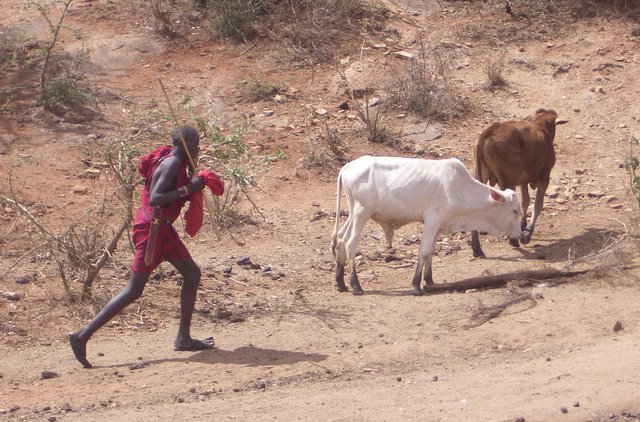
Maasai Herder: Livestock is their Livelihood.

The dams must be managed properly, however, or else they will erode away. Cattle must not walk on the dam itself. A fence is built around some of the dams to prevent contamination by animals, but this restricted access frustrates herders. Also, the waters from each rain wash silt into the dam, necessitating desilting with heavy machinery every 5-7 years. If there is an effective water managing committee, they can charge user fees and spend this money to maintain and improve the dam structure.

Joseph, the pump attendant, draws water with this diesel generator.

TD Jakes came to this area in September, supplying money for a water tank, borehole, troughs, pump and generator. Oftentimes, animals bathing in the dam water make it unsuitable for human drinking. With a borehole and generator to pump water from aquifers below, the Maasai now have ready access to safe water. They will collect user fees for humans and animals, using this money to pay for diesel to run the generator and for needed maintenance repairs .
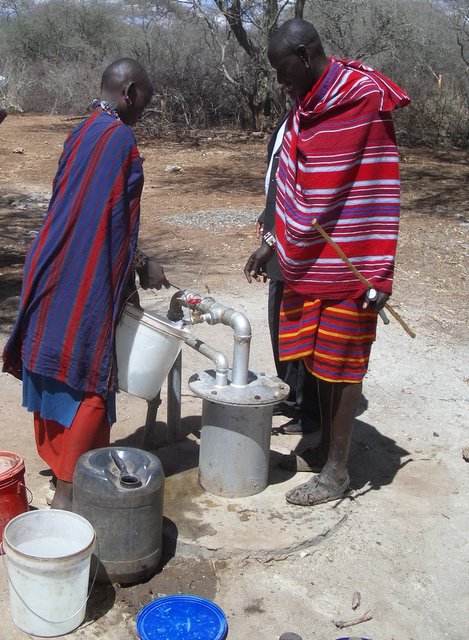
Noah, who donated the land for the borehole, watches his wife draw water.

CWS also encourages communities like this one to use this project as an asset for investing in their own future. For instance, the group has expressed its desire to pipe water to nearby schools. Instead of asking CWS for more money, they will use the excess water pumped from the ground to grow and sell vegetables. In this way, we hope to partner with the community, empowering them to help themselves and others.

Donkeys lounge around after drinking.

Sunday, November 27

"Let's go to church"

I was sitting at a matatu stop this morning, when a woman passing by looked me directly in the eye and said, "Let's go to church." Taken aback, I half-chuckled and mananged to mutter "nnmh," a Kenyan sound for agreement. Yet before I could say or do anything else, she was gone. I wanted to call after her, saying that -in fact- I am a Christian, I am going to church, and I am a volunteer missionary here in Kenya for one year. Regardless, I admired her audacity to just blurt out that statement.

And she got me thinking... what does it mean to "go to church"? If church is a community of believers, must everyone that comes first be a Christian? If church is simply a place where the presense of God is felt, then walls, fancy doors, stained-glass windows, a new organ, a steeple or cross aren't necessary. Or is it what Mother Teresa said, "You and I, we are the church, no?" Where do we find church?

I wonder if I'd already been to church. I live in a fairly well-to-do neighborhood, but that doesn't mean I don't see poverty each day. The beggars and street boys are attracted to this area exactly because there are people with money who live here. This morning, I was approached for money by a street kid. He wanted the money for hot tea. I asked if he would like crackers instead. As I reached into my bag, I saw the frisbee I was carrying. An idea popped into my head: Why not toss the frisbee this boy? I asked him if he'd ever thrown one before. He hadn't, but it didn't take him long to learn.

Almost immediately two other boys appeared, one with a bottle of glue in hand, which he'd been sniffing to stave-off the pains of hunger. They eagerly joined our game. And there we were, a well-to-do American tossing frisbee with three street boys in a parking lot that looked like it'd just been shelled. After a short while, I had to be on my way, and so I bid them good-bye, giving each a small packet of Ritz crackers.

I was on my way to church, but I couldn't help thinking: Wasn't this a picture of church?

Saturday, November 26

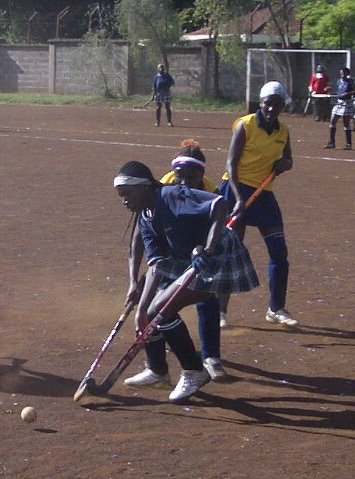
Field Hockey Tourney

This weekend I watched two friends battle it out on the field hockey field. "Field" is a loose term in Kenya, this time meaning a level, hard-packed dirt square with chalked lines. My friends' team, the Eaglets, won their semi-final game 3-1. (Right: Cathy jukes past someone, a-gain.) In the finals they lost a heart-breaker in overtime 2-1 when a girl on the opposing side kicked the ball in (it's illegal to touch the ball with anything but your stick). I think the referees were tired and just wanted the game to end. I've never been one to watch field hockey, but I enjoyed watching my friends play and even got riled up with the poor officiating. But maybe that's just me when I watch sports. I also brought my frisbee along and made a few friends teaching them how to throw. I'm beginning to feel more 'at home' here in Kenya, as I make friends and get involved in daily Kenyan life.

Njeri inbounds the ball.

Wednesday, November 23

Constitutional Referendum

This week Kenyans went to the polls to vote on a proposed constitution. Currently they use the one left over from independence in 1963. The main flaw in the old one is an imbalance of power between the executive and other branches of government. The proposed constitution fails to address this issue, although it does promote women's and land rights- two important issues that should be addressed as proposed bills in the legislature.

On Monday the 21st, Kenyans rejected the proposed constitution, 57-43%, with 55% of registered voters casting their ballot. The President and his administration had backed the proposed constitution, so its defeat did not bode well for the remaining two years of office. On Wednesday, the President sacked his entire cabinet, promising to reinstate a new one within two weeks. The opposition parties are pushing for him to dissolve Parliament as well, forcing elections much sooner than the present date in 2007.

So far things have been relatively peaceful. Life goes on, and for most people nothing has changed. As the politicians bicker and banter back and forth, the everyday person struggles to survive.

UPDATE: The President has dissolved parliament until further notice, and the opposition party is making demands for elections while holding outlawed rallies around the nation. As my coworker Mary remarked, "We no longer have a government." Still, life goes on and I see little change in people's lives. Please pray that all works out for the better.

Tuesday, November 22

American Traditions: MNF, Chinese & Tgiving Dinners

Today I went over to a friend's house, a Disciples of Christ missionary, to watch the Green Bay Packers take on the Minnesota Vikings in Monday Night Football... at 5 PM our time, Tuesday. An exciting game ended 20-17 when the Vikings kicked a game-winning field-goal. The satellite feed was interrupted numerous times, perhaps since it was a taped show on European ESPN broadcast through South Africa. Afterwards we went out for Chinese.

The day before we had Thanksgiving Dinner at our site coordinator's house: complete with pumpkin souflet, apple pie, string beans, stuffing and a huge turkey. There were no sweet or mashed potatoes; however, with any luck we'll have them in our SECOND T-GIVING DINNER on Friday... at another missionary's house.

So, family & friends partaking in a Thanksgiving Holiday weekend: Know that I am in good hands as we American missionaries take the week to celebrate many an American Tradition.

Sunday, November 20

Birthday Celebration

Today I hosted a birthday party for David, a friend of mine. I had wanted to make something American for all my guests, but with only a basic gas stove I decided to stick with something easy: stew, chapati & ugali. A friend of his, Nightingale, came over early to help me cook. I really enjoyed talking to her, especially when I discovered she was in a long-distance relationship herself. We exchanged dreams, hopes & concerns, and I found it very therapeutic to find commonalities.

The guests trickled in. The other volunteers came over first, including my roommate Will, as well as Andrea, Rachel, Brian & Katie. My two friends who played field hockey came over, Cathy & Njeri. Then finally David's friends came over: Sara, his girlfriend, Ken and James. Surprisingly, we had more than enough food to share with the guards! People mingled and ate, before we shut out the lights and I announced David as if he were a Chicago Bulls player. We made him dance for us for quite some time before we served dessert: coke floats. So at least they got something American.

Later we moved the party to the Klub House, or K1; a nice, two-level bar nearby made of large wooden beams. I split my time talking with my friends, playing pool with James, dancing with da ladies (sorry, no pics) and watching my favorite team, Barcelona, kick the tar out of Real Madrid, 3-0. And to top it all off, the bar tab was just over $20 for nine people! I must say, it was a fabulous night.

Apparently, Kenyans don't make a big deal out of birthdays. Marriages and funerals are a much bigger deal, as they are in the States, but birthdays not at all. It was David's 23rd birthday, and his first birthday celebration. I was more than happy to share it with him and our friends.

Saturday, November 19

A Woman's Experience

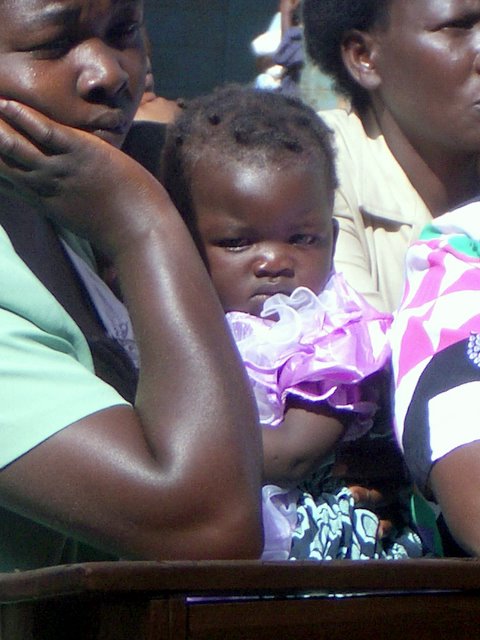
I arrived today at a school on the outskirts of Nairobi. The school, Mutuini, is part of our School Safe Zones (SSZ) initiative. The idea is to make schools safer for children, in hopes parents will feel confident leaving their children there for the day. So far we have provided money for a new gate and fence around the school, as well as some toilet and water catchment repairs. Our hope is that these improvements would not only improve the school's facilities, but also inspire students, teachers and parents alike to further support the school in whatever way they can.Accompanied by some local leaders, we had a meeting with the parents in the school. About 90% of those present were women, many carrying children. I was told that many - if not most - of the homes in this area were female, single-headed househoulds. There are many reasons for this, and traditionally the African man works outside of the house, going into the city, while the woman stays at home to do important housework. These women had walked many miles to arrive for this meeting; to sit in the hot sun, listen to various people talk, and have some white guy take their picture.
Many people gave speeches, and many more listened. My coworker Sarah thanked the parents for coming, saying how they were an integral part to the initiative. A representative from the government stressed the importance of education in poverty reduction. Two counselours spoke about alcoholism, one treating it as a disease and the other as lack of affection in the home. I had known that alcoholism was a problem, but was surprised at how matter-of-factly the community admitted women were routinely beaten by their husbands.

Who knows what awaits the return of these women: countless tasks when she is already exhausted from walking so far, a husband who is angry that dinner isn't ready yet, a child whimpering on the floor from the pain of a water-borne disease. The time spent going to this meeting might have prevented one woman from drawing water that day, another from selling a few pastries to pay for school supplies, and one more from preparing a meal.


I hope it was worthwhile.

Friday, November 18

A Typical Day in the Office

I've decided to do a 'bland' entry today, simplying writing about what my day looks like when I'm not traveling around to our various project sites. The purpose of this email is two-fold: to give some point of reference to those of you interested in what I do on a daily basis, and to hold myself accountable to whatever is I should be doing.

I arrive at work around 8:30 AM. After greeting the few co-workers already there, I turn on my computer. I then spend the next 10 to 15 minutes readying my daily devotionals - Daily Light and My Utmost for His Highest - as well as a few bible passages, occassionally writing in my journal. I then say a short prayer, sharing my thoughts, goals and worries for the day with God.

For the next hour or so I will read email, write a few of my own, and browse some websites (including this one). I then will begin working on numerous projects: articles for a newsletter, emails to a project partner, human interest stories, typing up notes from project visits, organizing photos from trips, downloading useful programs (like converting files to .pdf), ETC - end of thought capacity. I like to multi-task, and unfortunately my desktop computer doesn't like it when I have open AOL IM, MS Word, MS Publisher, Picasa, and Internet Explorer; not to mention how many windows of each. So some of my time is spent waiting on ol' slug-butt here to get on with it.

Often I am easily distracted by a co-worker, who tends to ask one of three questions (or all three):
- Habari yako? (How are you?)
- Would you like to come with me to [place] to do [action]?
- I want to do [this] on my computer. Can you show me how?

For example, yesterday I was invited to a school to take pictures at a parents' meeting. Invariably, we'll pick up some other people involved in our work and take longer than expected. I enjoy this, however, as I get to meet new people and get out of the office. Today I helped Sammy, my co-worker in the Emergency Response Program department, find some photos from last year and insert them into Word. Usually I pack a lunch, but today I was invited to each lunch with some partners at our office for a meeting. Luckily, I haven't had to attend too many meetings thus far.

All of my co-workers are very hard-working, competent Kenyans and I thoroughly enjoy working with them. Since I don't make direct decisions about the projects themselves, I play a more observer role rather than participant. Even so, I enjoy listening and helping out where I can.

Tuesday, November 15

Aerobics

Today I went to Kikuyu, a small town outside of Nairobi. When my family comes over Christmas, we will be volunteering at an orphanage here, building a puppet theater, playing games and enjoying time with the children. I had only been there once before, yet the Kenyans warmly welcomed me to their home. I'm very excited about working with them and spending a week in a close Kikuyu community.

My friend and fellow volunteer, Rachel (or Lachel, as her students say her name), invited me to Aerobics class... at an all-girls academy. All I can say is, doing aerobics in boots and jeans is awkward enough. Afterwards we stumbled upon a high school girls function. I thought it was a dance party, but apparently they were just pre-partying before a movie screening. I showed 'em a few of my mzungu moves before piecin' out, straight thug-struttin'.

David, our aerobics instructor and the only other male in the class, walked home with us and mentioned that it was his birthday in a few days. Being pumped-up from the dancing, I suggested he come to Nairobi Saturday and take us to the bumpin' clubs; my treat. As we parted, he exclaimed he had never celebrated his birthday before. I hope everything works out and we can have a lil' shindig for him.

Monday, November 14

Lake Nakuru Game Park

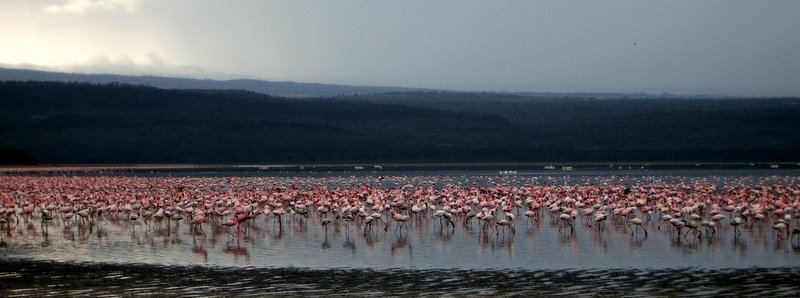
After completing our safari (literally "journey" in Kiswahili) across Kenya, we ended at Lake Nakuru Game Park for what we Americans traditionally call a safari. The game reserve is one of the most accessible, surrounding a shallow lake. I was told its deepest point was only 10 feet. Enjoy.

How many monkeys in the photo?


Waterbucks: Postcard, anyone?


Flamigo Party, Lake Nakuru


White Rhino
(name not based on skin color but something to do with mouth)


Pelicans do a fly-over